
DIY can be reasonable when a deck is low, easy to reach, structurally simple, and manageable to dismantle and haul away. For deck demolition in St. Petersburg, professional removal may be more practical when the deck is elevated, badly deteriorated, attached to the home, or difficult to access. Consider the work’s scope, safety risks, debris handling, and the time and equipment available.
Deck boards may look quick to remove, but demolition involves more than the surface: railings, framing, fasteners, and heavy debris all need attention, and limited access can complicate each step. This guide compares DIY and professional removal, including access, hazards, scope, and cost factors. It also explains when a hands-on approach may be manageable and when professional help can simplify a more complex job.
Key Takeaways
- Plan the teardown in a safe sequence, starting with railings and considering how boards and framing can be removed in manageable sections.
- Use deck height, stability, and the path for carrying debris away to judge whether the work is practical to handle yourself.
- Choose DIY only when the scope, tools, and debris handling are manageable; complex or unsafe conditions can make contractor help the more practical option.
- Expect removal costs to depend on access, debris volume and weight, labor, and disposal requirements, not just the deck’s visible size.
Removing railings, deck boards, and joists
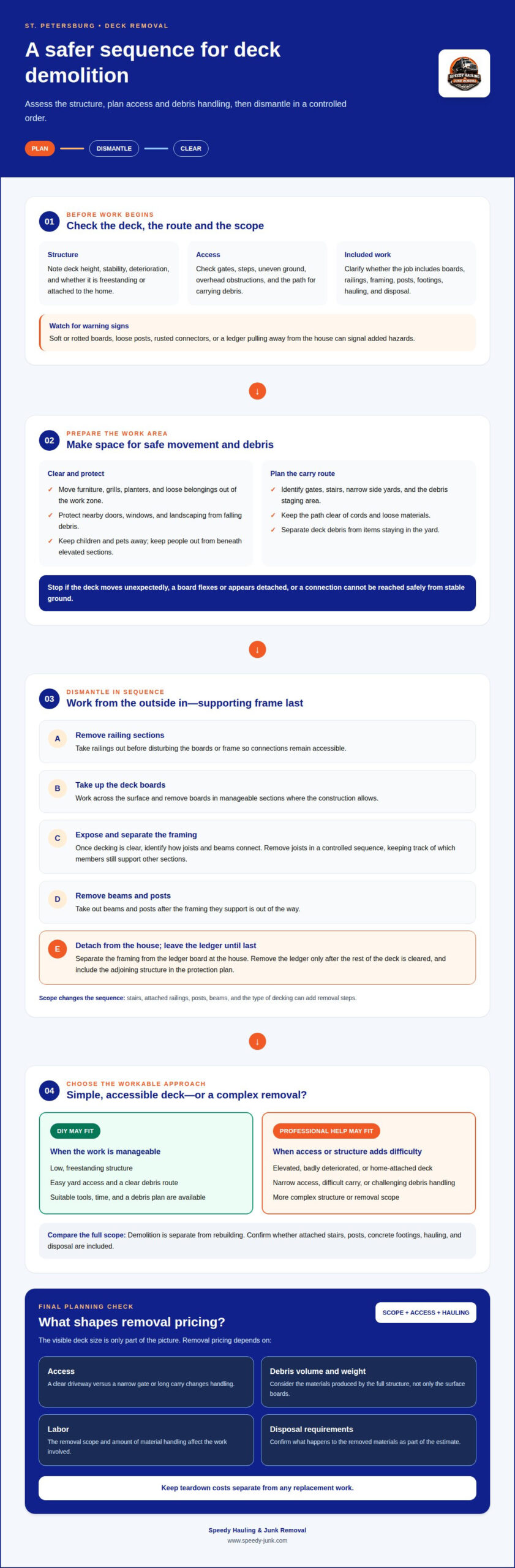
For deck demolition in St. Petersburg, an orderly teardown often starts with the railings. Remove railing sections before disturbing the boards or frame so they do not block access to fasteners and connections. Then work across the surface, taking boards apart in manageable sections where the construction allows. Removing boards and joists in sections can be more efficient than handling every board separately.
Once the decking is clear, expose the joists and beams to see how the frame connects. Separate joists in a controlled sequence, keeping track of which members still support other sections. Remove beams and posts after the framing they support is out of the way. At the house, the ledger board connects the deck to the structure. Detach the framing from it, and leave ledger removal until the rest of the deck is cleared.
The scope depends on the structure. A low, freestanding wood platform has different connections from an elevated deck attached to a home. Composite boards may need different handling from wood, while stairs, posts, beams, and attached railings add removal steps. Include these components in the plan rather than treating the visible deck surface as the entire job.
Fencing may also be part of a property cleanup. Wood panels, vinyl sections, and chain-link fencing each have different connections to posts and gates. Identify where the fence ends and the deck work begins, especially when both sit along the same yard boundary. Debris hauling can address the hauling side of a project that produces bulky materials.
There is no fixed timeline for deck demolition and cleanup in St. Petersburg. The schedule depends on the deck’s dimensions, access, connections, condition, removal scope, and debris route. Plan for both dismantling and hauling: cutting boards is only one part of clearing the area.
Assessing access and safety hazards
Start by checking the route from the deck to the street. Measure narrow gates, note steps and uneven ground, and identify anything that could obstruct carrying boards or framing. Move patio furniture, grills, and planters out of the work zone. Keep children and pets away during demolition, and protect nearby doors, windows, and landscaping from falling debris.
To prepare a deck for demolition and removal, clear loose belongings and make the debris route accessible. Identify where the deck meets the house and note stairs, fences, and overhead obstructions before work begins. A narrow side yard or a deck above a lower level can limit the size of pieces that can be moved safely.
DIY demolition can expose you to falls, unstable framing, sharp fasteners, splinters, and tools contacting hidden connections. A weakened railing may shift under pressure, while removing a supporting beam too early can destabilize the remaining structure. Stop if the deck moves unexpectedly or you cannot reach a connection safely from stable ground.
Look for warning signs such as soft or rotted boards, loose posts, rusted connectors, or a ledger pulling away from the house. Keep people out from beneath elevated sections, and do not stand on boards that flex or appear detached. A second-story deck with a narrow stairway, for example, combines height, limited access, and difficult debris handling.
Access also affects cleanup. A clear driveway can make debris staging easier, while a long carry through a side gate adds handling and labor. Keep the path free of cords and loose materials, and separate deck debris from items staying in the yard. Include access details and the debris route in your removal plan so the work area stays organized.
DIY versus contractor demolition
DIY may suit a low, freestanding deck when you have suitable tools, time, and a debris plan. A small platform with open yard access is a different task from an elevated deck attached to a house. Look beyond dismantling: the project also involves moving materials, managing the work area, and deciding how to use the cleared space.
Contractor demolition can be a more practical fit when the deck is raised, badly deteriorated, or connected to the home. Deck demolition contractors in St. Petersburg, FL handle projects with different structures and removal scopes. Licensing and insurance describe contractor credentials; the removal plan still needs to define what happens to the deck, attached stairs, and debris.
To understand the work involved, define the scope before choosing an approach. Does it cover only the surface, or the full structure and debris hauling? Are posts and concrete footings included? A clear scope distinguishes demolition from rebuilding, which is separate work and changes what the project includes.
DIY also means organizing tools, labor, debris staging, and disposal. A narrow gate can make carrying materials difficult even when the deck is modest. A removal estimate may account for access, material volume and weight, labor, and disposal requirements. These factors offer a more useful basis for comparison than deck size alone.
For homeowners weighing how to find licensed and insured deck demolition contractors in St. Petersburg, those credentials are one part of a contractor’s professional profile, while the written scope clarifies the actual work. Consider how the deck is connected, whether the framing is sound, and whether the debris can be moved safely through the property. DIY may suit a simple, accessible structure; a complex removal calls for a more comprehensive plan.
Before work begins, inspect the connection at the house. A gap at the flashing can let debris collect and hold water, contributing to rot. Include the adjoining structure in the removal plan and protect it during the work.
Deck demolition costs
Removal pricing depends on the scope, access, labor, debris volume and weight, and disposal requirements. Keep teardown costs separate from any replacement work when planning your budget.
Demolition Cost Factors
Ask what the estimate covers: decking, railings, framing, posts, footings, hauling, and disposal. A clear driveway and short carry can reduce handling compared with a narrow gate or long route. Volume and weight matter, too. Concrete footings are priced by weight rather than volume, so they may be handled separately from lumber.
For an accurate comparison, define what stays and what goes. Removing only the surface boards differs from dismantling the frame and hauling all debris. Disposal needs also affect the scope, especially for treated lumber. Do not use the deck’s visible footprint as the only cost factor.
Demolition and Replacement Costs
Demolition means taking apart and removing the existing structure. Replacement is a separate project involving new materials, design choices, and construction labor. Compare estimates only when each clearly states whether it includes removal, disposal, footings, and rebuilding.
Clearing a damaged deck is not the same project as replacing it with a larger platform. Keep those scopes distinct to decide whether you need removal only or a separate construction project afterward.
Permit Requirements
Waterfront deck demolition in Florida may involve permits and environmental review. Waterfront structures may fall under county, Florida Department of Environmental Protection, or U.S. Army Corps of Engineers jurisdiction. Requirements depend on the site and project, so do not assume waterfront removal follows the same process as inland deck removal.
Disposal matters too. Pressure-treated lumber installed before roughly 2004 was often treated with CCA, which contains arsenic. Pinellas County requires an appointment for special handling; according to Pinellas County, the service fee is $110 per load, plus a standard disposal fee of $63.57 per ton. CCA-treated wood should never be burned or reused in garden beds or play areas.
Speedy Hauling & Junk Removal
Speedy Hauling & Junk Removal can help when deck removal is part of a larger property cleanup. If unwanted furniture or appliances are also in the way, the team can remove them as part of preparing the space for its next use. The company also handles garage and hoarder cleanouts.
Before arranging removal, consider what needs to go, how items can be accessed, and whether cleanup extends beyond the deck. A clear scope helps identify the right next step without confusing debris removal with rebuilding or replacement.
Contact Speedy Hauling & Junk Removal to discuss your cleanup needs and request a free, no-obligation estimate.
Plan the space that comes next
Before moving ahead, decide how you want the cleared area to serve your property. An open yard, a future deck project, and a larger outdoor layout each call for a different end point. This decision helps keep removal focused on what you need rather than treating demolition as the whole plan.
For deck demolition in St. Petersburg, Speedy Hauling & Junk Removal provides deck removal to help clear the structure and move your project forward. Consider whether you want only the deck removed or the surrounding area cleared as well. Having that goal in mind makes the estimate conversation more useful and clarifies the work.
A clear plan is a practical first step toward making the space usable again.
Frequently Asked Questions
Should you DIY or use a contractor to demo your deck?
DIY can make sense for a low, freestanding deck when you have the tools, time, and a workable debris plan. For deck demolition in St. Petersburg, consider professional removal if the structure is attached, elevated, unstable, or difficult to reach. Weigh whether you can manage the full cleanup, not just dismantling. A manageable teardown can become a bigger task when hauling debris requires repeated trips.
What is the average cost to demolish a deck in St. Petersburg, Florida?
There isn’t one average that fits every St. Petersburg deck. The estimate depends on the amount and weight of material, access from the yard to the pickup area, labor, and disposal requirements. A small, accessible structure and a large deck with awkward access have different removal needs. The price depends on the project and is provided after a quote request.
What is the deck demolition cost per square foot in Pinellas County?
A per-square-foot figure alone cannot account for the details that shape a Pinellas County removal estimate. Deck dimensions help describe the job, but material volume, weight, access, labor, and disposal requirements also matter. Two decks with the same footprint may have different framing or different routes for carrying debris. Request an estimate based on the actual removal scope rather than square footage alone.

Article by
ALBERTO HERNANDEZ
Alberto Hernandez is the owner of Speedy Hauling & Junk Removal, a family-owned junk removal and light demolition company serving Tampa Bay. With years of hands-on experience completing residential and commercial junk removal, property cleanouts, debris hauling, and light demolition projects, Alberto shares practical information based on real jobs and real customer needs throughout the Tampa Bay area.